Imagine the government told you that you could not criticize a political leader, practice your religion, join a peaceful protest, or refuse an unreasonable search of your home.
In the United States, constitutional protections known as civil liberties help limit that kind of government interference.
But what are civil liberties exactly?
Civil liberties are fundamental freedoms protected primarily by the U.S. Constitution, especially the Bill of Rights. Rather than simply giving people permission to do certain things, many of these protections restrict what the government may do to individuals.
Cornell Law School’s Legal Information Institute describes civil liberties as fundamental freedoms protected from government interference.
They include familiar ideas such as freedom of speech, religious liberty, freedom of the press, privacy protections, and due process.
Understanding civil liberties is important because these freedoms affect everyday life, political participation, criminal justice, education, protests, technology, and the relationship between individuals and government.
What Are Civil Liberties?
At their core, civil liberties are protections that limit government power over individual freedom.
The U.S. Bill of Rights-the first ten amendments to the Constitution-is one of the main sources of these protections.
According to the National Archives, the Bill of Rights describes Americans’ rights in relation to government and protects liberties such as speech, press, religion, and due process.
Think about civil liberties as boundaries around government authority.
The government has legitimate powers. It can enforce criminal laws, collect taxes, regulate businesses, and maintain public safety. But constitutional protections can prevent government officials from exercising those powers in certain ways.
For example, government officials generally cannot punish someone simply because they dislike that person’s political opinion.
That does not mean every freedom is unlimited. Courts frequently have to determine how individual liberty should be balanced against legitimate government interests.
Where Do Civil Liberties Come From?
Many of the best-known American civil liberties come from the Bill of Rights, ratified in 1791.
Different amendments protect different freedoms.
The First Amendment addresses religion, speech, press, assembly, and petition. The Fourth Amendment protects against unreasonable searches and seizures.
The Fifth Amendment includes protections involving due process and self-incrimination, while the Sixth Amendment provides important protections for people accused of crimes.
Originally, the Bill of Rights primarily restricted the federal government.
Over time, the Supreme Court applied most Bill of Rights protections against state and local governments through the Fourteenth Amendment, using a process generally known as selective incorporation.
This development greatly expanded the practical importance of constitutional liberties across the United States.
Freedom of Speech and Expression
Perhaps the most famous American civil liberty is freedom of speech.
The First Amendment restricts government interference with freedom of speech while also protecting the press, religious liberty, peaceful assembly, and the right to petition government.
Freedom of expression matters because democratic societies depend on people being able to debate ideas, criticize officials, discuss public policies, and advocate political change.
Imagine someone stands outside city hall holding a sign criticizing the mayor.
Government officials generally cannot arrest that person merely because the message is embarrassing or unpopular.
Is Every Kind of Speech Protected?
No.
Freedom of speech is broad, but it is not an unlimited right to say anything, anywhere, under every circumstance.
American courts have developed rules concerning areas such as threats, defamation, obscenity, incitement, and regulations governing when, where, and how certain expressive activities may occur.
Context matters enormously.
It is also important to remember that the First Amendment primarily restricts government action. A private employer or privately owned platform is not automatically subject to the same constitutional rules simply because it limits someone’s speech.
Freedom of Religion
Religious liberty is another central civil liberty.
The First Amendment contains two important protections involving religion: the Establishment Clause and the Free Exercise Clause.
Broadly speaking, these provisions restrict government establishment of religion while also protecting religious exercise.
Constitution Annotated explains that the Religion Clauses prevent government from establishing religion and prohibit government from interfering improperly with religious exercise.
Imagine that a government required everyone to follow one officially approved religion.
That would raise an obvious constitutional problem.
The real cases are usually more complicated. Courts may have to balance religious liberty against generally applicable laws, government programs, public education policies, workplace regulations, or other public interests.
That is why religious freedom continues to generate significant constitutional litigation.
Privacy and Protection From Government Searches
Another major category of civil liberties involves privacy and personal security.
The Fourth Amendment protects people against unreasonable government searches and seizures.
It specifically establishes constitutional requirements concerning searches and warrants, including probable cause and particularity requirements. Courts have also recognized various circumstances in which warrant requirements operate differently or exceptions may apply.
Imagine police officers want to search someone’s home for evidence of a crime.
They generally cannot simply enter whenever they feel like it. Constitutional rules determine when a warrant is needed, how probable cause works, and when exceptions may permit warrantless action.
Modern technology has made these questions even more interesting.
Smartphones, location information, digital communications, surveillance cameras, biometric technology, and online data continually create new questions about the boundaries between personal privacy and government authority.
Due Process and Fair Government Procedures
Civil liberties are not limited to speech and privacy.
Due process protects individuals from certain arbitrary government actions.
The Fifth Amendment contains a Due Process Clause applicable to the federal government, while the Fourteenth Amendment prohibits states from depriving a person of life, liberty, or property without due process of law.
Constitution Annotated explains that procedural due process can require government officials to follow appropriate procedures before depriving someone of protected life, liberty, or property interests.
Imagine a government agency suddenly cancels someone’s legally protected benefit without providing the procedure that the law requires.
That could raise a due-process issue.
In criminal cases, related constitutional protections can involve notice of accusations, legal procedures, counsel, trials, evidence, and protections against certain forms of government coercion.
The basic principle is straightforward: government cannot always take significant action against an individual simply because an official wants to do so.
Freedom of Assembly and Protest
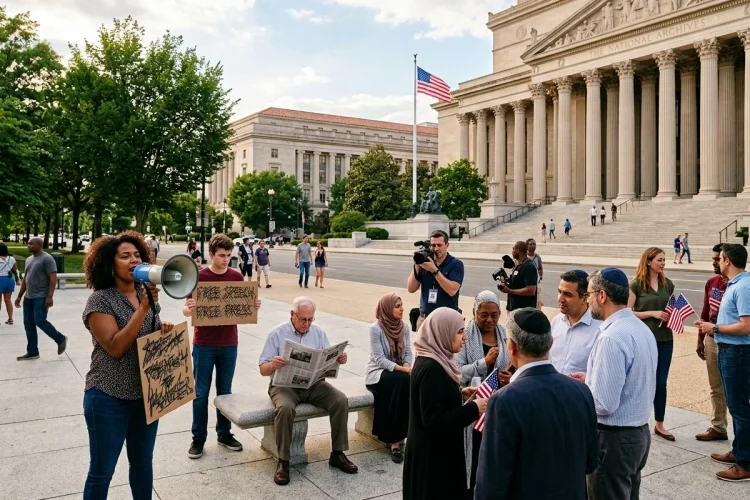
The First Amendment also protects the right of people to peaceably assemble.
This liberty allows individuals to gather for political meetings, demonstrations, marches, protests, and other forms of collective expression.
Peaceful assembly is closely connected with freedom of speech.
A person holding a sign alone is expressing an opinion. Thousands of people gathering together to advocate the same position combine speech with assembly.
The First Amendment also protects the right to petition government for redress of grievances. Federal courts recognize speech, religion, press, assembly, and petition as the five core freedoms expressly protected by the First Amendment.
Governments may still impose certain lawful regulations involving issues such as public safety, traffic, permits, or the use of particular public spaces.
Again, constitutional disputes often involve determining when regulation becomes an unlawful restriction on freedom.
Civil Liberties vs Civil Rights: What Is the Difference?
People often use civil liberties and civil rights interchangeably, but they describe somewhat different legal ideas.
Civil liberties generally focus on freedom from improper government interference.
Civil rights more often concern legal protections guaranteeing equality and protection from discrimination.
For example, freedom of speech is a classic civil liberty.
A law prohibiting employment discrimination based on a legally protected characteristic is more commonly discussed as a civil-rights protection.
Cornell explains the distinction by describing civil liberties as individual freedoms protected against government interference, while civil rights involve enforceable legal protections concerning equal treatment and discrimination.
The categories can overlap.
Religious freedom, for example, can involve constitutional protection against government interference as well as statutory protection against religious discrimination.
Are Civil Liberties Absolute?
One of the biggest misconceptions about constitutional freedoms is that they are absolute.
Most are not.
The fact that a particular activity involves a constitutional liberty does not automatically mean government can never regulate it.
For example, freedom of assembly does not necessarily give protesters permission to block an airport runway.
Free speech does not eliminate every law involving threats, fraud, or defamation. Fourth Amendment protections also contain legal standards and exceptions developed through extensive case law.
Courts therefore frequently balance government authority against constitutional protections.
The strength of government justification required can depend on which liberty is involved, what type of restriction has been imposed, and what constitutional legal standard applies.
This is why statements such as “I have a constitutional right, so the government cannot regulate me” are usually too simplistic.
Why Civil Liberties Matter in Everyday Life
Civil liberties are not only courtroom concepts.
They affect students discussing politics, journalists investigating government, religious communities practicing their faith, protesters demonstrating in public, defendants facing criminal charges, and ordinary people interacting with police.
They are also increasingly relevant online.
Questions about government surveillance, digital privacy, social media restrictions involving public officials, facial recognition, artificial intelligence, and access to electronic devices can all raise constitutional issues.
Civil liberties ultimately help define the relationship between individual freedom and government authority.
Without enforceable limits on government power, freedoms might depend largely on whether current officials were willing to tolerate them.
Constitutional protection makes those boundaries legal questions rather than simply political promises.
How Are Civil Liberties Protected?
Courts play a major role in interpreting civil liberties.
When someone argues that government action violates the Constitution, courts may examine the challenged law or policy and determine whether it complies with constitutional requirements.
Supreme Court decisions have therefore shaped what concepts such as freedom of speech, religious liberty, due process, and unreasonable search mean in real situations.
This also explains why constitutional rights evolve through case law.
The Constitution contains relatively short phrases, while real-world disputes can involve incredibly complicated facts.
Judges must determine how those broad principles apply to schools, workplaces, police investigations, protests, new technologies, national security issues, and many other situations.
As technology and society change, constitutional interpretation continues to face new questions.
So, what are civil liberties? They are fundamental freedoms that protect individuals against certain forms of government interference.
In the United States, many of the most important protections come from the Bill of Rights and include freedom of speech, religion, press, assembly, privacy-related protections, and due process.
These liberties are powerful, but they are not always absolute. Courts regularly determine where individual freedom ends and legitimate government authority begins.
Understanding civil liberties makes constitutional law-and everyday political news-much easier to follow.
The next time you hear that a government policy “violates someone’s rights,” look deeper. Ask which constitutional liberty is involved, what government action occurred, and what legal limits apply. That is where meaningful constitutional analysis begins.