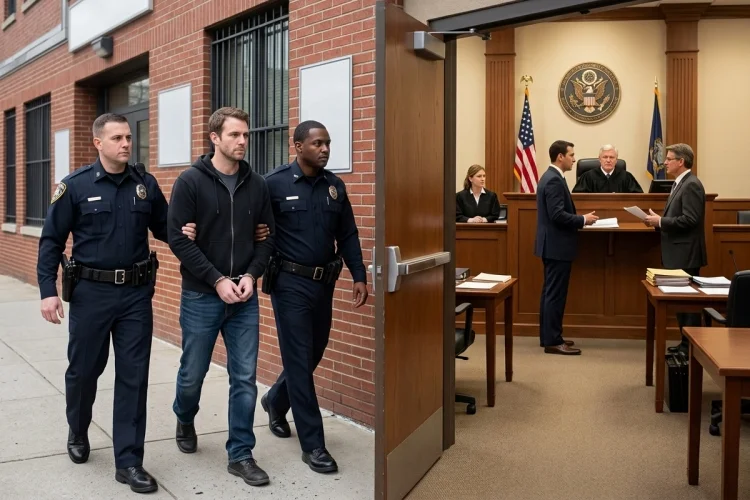
Getting arrested can look straightforward in movies: police put someone in handcuffs, read a warning, and the next scene jumps straight to a courtroom. In real life, several important steps usually happen between an arrest and a criminal trial.
So, what happens after someone is arrested?
In the United States, the answer depends partly on whether the case is handled under federal or state law. Every state has its own criminal procedures, while federal cases follow the Federal Rules of Criminal Procedure and related federal laws.
Still, many systems follow a broadly similar path involving booking, an initial court appearance, decisions about release or detention, formal charges, arraignment, discovery, plea negotiations, and possibly trial.
One point is especially important: an arrest is not a conviction. It begins a legal process in which prosecutors still have to establish the case and defendants have important constitutional and procedural rights.
Here is what that process usually looks like.
Step 1: The Person Is Taken Into Custody
An arrest occurs when law enforcement uses legal authority to significantly restrict someone’s freedom of movement.
Police generally need probable cause to make an arrest. Probable cause means the facts and circumstances known to officers provide a reasonable basis to believe that a crime has been committed and that the person arrested was involved.
An arrest can happen under a warrant issued by a judge or, in many circumstances permitted by law, without one.
For example, if an officer personally witnesses a qualifying crime, the officer may be able to make an immediate arrest without first obtaining a warrant.
Once the person is arrested, they are commonly transported to a police station, detention facility, or jail for processing.
Step 2: Booking Usually Comes Next
One of the first practical steps after arrest is booking.
Booking is the administrative process of entering the arrested person’s information into the criminal justice system.
Procedures differ between jurisdictions, but they often include recording the person’s name and identifying information, taking fingerprints and photographs, checking for outstanding warrants, documenting the alleged offense, and securing personal belongings.
A medical screening may also occur.
Booking is important because it creates the official record connecting the individual to the arrest and detention.
It does not, however, determine whether the person is guilty.
That question can only be resolved later through a guilty plea or criminal adjudication.
Step 3: What About Miranda Rights?
This is where television creates one of the biggest misconceptions about arrests.
Police do not necessarily have to read the Miranda warning at the exact moment someone is arrested.
Miranda protections are primarily triggered when two conditions come together: a person is in custody and law enforcement wants to interrogate them.
Before custodial interrogation, the person must generally be informed of rights including the right to remain silent, that statements can be used against them, the right to an attorney, and the right to appointed counsel if they cannot afford one.
Suppose police arrest someone, place them in a patrol vehicle, and transport them to jail without asking investigative questions.
The lack of an immediate Miranda warning does not automatically make the arrest invalid.
But if officers later conduct custodial interrogation without providing the required warnings or obtaining a valid waiver, statements obtained may face exclusion from the prosecution’s case.
Step 4: Prosecutors Review the Case
Police make arrests, but prosecutors generally decide whether a criminal prosecution will move forward and which charges to pursue.
Investigators provide reports, evidence, witness information, and other materials to the prosecutor.
In federal cases, a U.S. Attorney’s Office represents the government. State and local cases may involve district attorneys, state’s attorneys, county prosecutors, or officials with similar titles.
An arrest therefore does not guarantee that formal charges will ultimately proceed exactly as police initially expected.
Prosecutors may decide that evidence supports multiple charges, a lesser charge, or potentially no prosecutable case.
For many federal felony prosecutions, a grand jury is involved in determining whether sufficient evidence exists to issue an indictment, unless the defendant validly waives that requirement in situations where waiver is permitted.
Step 5: The Initial Court Appearance
After an arrest, a defendant must be brought before a judicial officer without unnecessary delay.
In federal proceedings, an initial appearance often happens shortly after arrest before a magistrate judge.
The judge explains the charges and important rights, addresses representation by an attorney, and considers whether the defendant should remain detained or be released while the case continues.
This hearing is important because police do not simply get unlimited authority to hold someone indefinitely without judicial oversight.
For a warrantless arrest, constitutional rules require a prompt judicial determination of probable cause. Cornell’s legal overview notes that this determination is generally required within 48 hours.
The details can differ substantially in state courts.
Step 6: The Judge Decides Release or Detention
Another major question after arrest is whether the defendant will remain in custody while awaiting further proceedings.
People often refer to this entire issue as bail, but modern pretrial release systems can involve much more than simply paying money.
In the federal system, a judge considers whether the defendant can safely be released and whether the person is likely to return for court proceedings.
Pretrial services officers may investigate factors such as residence, employment, family ties, criminal history, financial circumstances, and other relevant information.
A released defendant may also face conditions.
These might include reporting to pretrial services, restrictions on travel, electronic monitoring, drug testing, avoiding certain people, or other requirements appropriate to the case.
In other circumstances, the court may order detention pending trial.
Release and bail rules vary considerably between federal and state systems.
Step 7: Formal Charges and Arraignment
Eventually, the defendant must know precisely what criminal accusations they are facing.
Formal federal charges may come through an indictment issued by a grand jury or, in appropriate circumstances, an information filed by the prosecutor.
The defendant then appears for an arraignment.
At arraignment, the charges are formally presented and the defendant enters a plea. Common pleas include guilty and not guilty, although additional plea rules can depend on the jurisdiction.
Cornell describes arraignment as the stage where the defendant appears before the court, hears the charges, and enters a plea.
If the defendant pleads not guilty, the case generally continues toward additional pretrial proceedings.
A guilty plea can move the case toward sentencing without a full criminal trial.
Step 8: There May Be a Preliminary Hearing
Some cases involve a preliminary hearing to determine whether enough evidence exists for the prosecution to continue.
This is not the same thing as a trial.
At a federal preliminary hearing, the government must demonstrate probable cause that the defendant committed the charged offense. Witnesses and evidence may be presented, and the defense may have an opportunity to cross-examine witnesses.
However, preliminary hearings are not required in every case.
For example, federal grand jury proceedings can affect whether such a hearing is necessary, and defendants can sometimes waive the hearing.
The standard at this stage is also much lower than the beyond a reasonable doubt standard required for a conviction at trial.
Step 9: Discovery and Plea Negotiations Begin
If the case continues, prosecutors and defense lawyers prepare for what comes next.
An important stage is discovery, where the parties exchange or disclose certain evidence according to applicable criminal procedure rules.
Defense lawyers need to understand the government’s case, including relevant documents, statements, physical evidence, expert evidence, and other materials subject to disclosure requirements.
Plea negotiations may also occur.
A defendant might agree to plead guilty to certain charges in exchange for concessions from prosecutors, although plea agreements remain subject to legal rules and judicial procedures.
In the federal court system, most criminal cases do not ultimately reach a full jury trial. U.S. Courts notes that more than 90% of federal criminal defendants plead guilty rather than proceed to trial.
Step 10: Lawyers Can File Pretrial Motions
Before trial, both sides may ask the judge to decide important legal questions.
These requests are called pretrial motions.
For example, a defense lawyer might file a motion to suppress evidence allegedly obtained through an unconstitutional search.
A motion to dismiss might argue that charges should not proceed for a particular legal reason. Other motions can involve witnesses, evidence, venue, or courtroom procedures.
This stage can dramatically change a case.
If critical evidence is excluded, the prosecution’s case may become significantly weaker.
That is why criminal procedure is not simply about whether someone committed an alleged act. It also examines how the government obtained and uses its evidence.
Step 11: The Case May Go to Trial
If the defendant pleads not guilty and the case is not otherwise resolved, it may eventually proceed to trial.
At a criminal trial, prosecutors carry the burden of proving the defendant guilty beyond a reasonable doubt.
The defendant does not have to prove innocence.
Evidence and witness testimony are presented under rules supervised by the judge.
In a jury trial, jurors determine whether the prosecution has established guilt. If the defendant is found not guilty, the defendant is acquitted.
If convicted, the case moves toward sentencing.
The process may continue even after that through post-trial motions and appeals.
Arrest Does Not Mean Guilt
Perhaps the most important point for beginners is that arrest, charge, and conviction are three different things.
An arrest means police have taken someone into custody under legal authority.
A charge means prosecutors formally accuse the person of committing an offense.
A conviction means the defendant has been found guilty through a trial or has entered a legally accepted guilty plea.
Confusing these stages can lead to inaccurate assumptions, especially when reading crime reports or breaking news.
Someone described as “arrested for” or “charged with” an offense is still accused-not automatically legally guilty.
So, what happens after someone is arrested? In the United States, the process commonly includes booking, possible custodial questioning, prosecutor review, an initial court appearance, decisions about pretrial release or detention, formal charges, arraignment, discovery, plea negotiations, and possibly trial.
The exact sequence can differ depending on whether the case is federal or state, the seriousness of the alleged offense, and the local procedural rules.
Most importantly, an arrest is only the beginning of the criminal justice process-not proof of guilt.
If you want to understand criminal cases more clearly, start paying attention to the terminology used in news reports: arrested, charged, indicted, arraigned, released, pleaded guilty, tried, and convicted all describe very different stages.