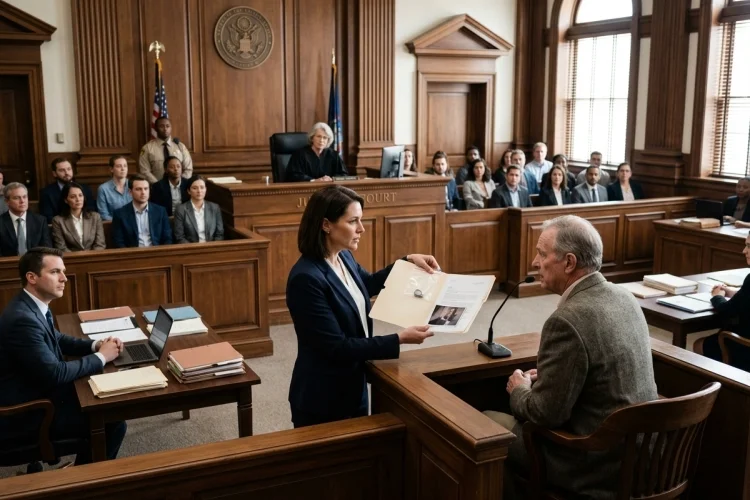
Courtroom dramas make evidence look simple. A lawyer discovers a shocking email, a witness reveals an important secret, or investigators find a crucial photograph-and suddenly the case seems solved.
Real courts do not work quite like that.
Before information can be presented to a judge or jury, lawyers may have to answer an important question: Is this evidence legally admissible?
That is where evidence law comes in.
Evidence law is the body of rules governing what information can be presented in court and how that information may be used. In U.S. federal courts, the Federal Rules of Evidence govern the admission or exclusion of evidence in most proceedings.
These rules cover subjects such as relevance, hearsay, witness testimony, expert opinions, authentication, privileges, and unfair prejudice.
Understanding evidence law matters because trials are not simply contests to see which side can present the most information. Courts need evidence that is sufficiently relevant, reliable, and legally appropriate to help determine what actually happened.
What Is Evidence Law?
Evidence law determines what information a court may consider when deciding a case.
Evidence can take many forms. A witness might describe what they saw. A lawyer might introduce an email, photograph, contract, medical record, video, weapon, financial statement, or digital file.
But possessing information does not automatically make it admissible.
The Federal Rules of Evidence contain rules addressing relevance, character evidence, privileges, witnesses, expert testimony, hearsay, authentication, and documents or recordings.
Evidence rules apply in both civil and criminal federal cases, although particular constitutional protections and procedural rules can create important differences.
A murder trial, for example, might involve forensic evidence and eyewitness testimony. A contract lawsuit might involve emails, invoices, business records, and testimony about negotiations.
In both cases, the court must decide what information the factfinder is legally allowed to consider.
Why Relevance Is the Starting Point
One of the first questions lawyers ask about evidence is simple:
Does this information actually help prove something important in the case?
Under Federal Rule of Evidence 401, evidence is relevant when it has some tendency to make an important fact more or less probable than it would be without that evidence.
Imagine someone is accused of robbing a convenience store at 10 p.m.
Security footage showing that person entering the store at 9:58 p.m. would obviously be relevant. A photograph showing what the defendant ate for breakfast three weeks earlier probably would not be.
Relevant evidence is generally admissible unless another legal rule requires or permits its exclusion. Irrelevant evidence is not admissible in federal court.
Relevance sounds straightforward, but real cases can make it surprisingly complicated.
Evidence does not always need to prove the entire case by itself. Even a small piece of information can be relevant if it helps make an important fact slightly more or less likely.
Relevant Evidence Can Still Be Excluded
Here is one of the most important lessons in evidence law:
Relevant does not always mean admissible.
Federal Rule of Evidence 403 allows a court to exclude relevant evidence when its probative value is substantially outweighed by dangers such as unfair prejudice, misleading the jury, confusing the issues, wasting time, or presenting unnecessary cumulative evidence.
Suppose a prosecutor has an extremely graphic photograph from a crime scene.
The photograph might genuinely help prove an important fact. But if dozens of similar images have already established the same point, the judge could consider whether another disturbing photograph adds enough evidentiary value to justify its potential prejudicial effect.
“Unfair prejudice” does not simply mean evidence is damaging.
Most useful evidence hurts one side’s case.
The concern is whether evidence could push the jury toward a decision for an improper reason-such as extreme emotion-rather than helping them rationally evaluate the facts.
What Is Hearsay?
Few evidence-law terms confuse beginners more than hearsay.
A common misconception is that hearsay means anything one person heard from someone else.
The legal definition is more specific.
Under Federal Rule of Evidence 801, hearsay generally involves an out-of-court statement offered to prove the truth of what that statement asserts.
Imagine a witness testifies:
“Maria told me that she saw Daniel steal the laptop.”
If the statement is offered to prove that Daniel actually stole the laptop, it may raise a hearsay issue because Maria made the statement outside the current courtroom testimony.
Why Is Hearsay Often Restricted?
One concern is reliability.
If Maria is not testifying, the opposing lawyer may not have an opportunity to question her memory, perception, honesty, or wording.
Federal Rule of Evidence 802 generally excludes hearsay unless another rule, federal statute, or applicable rule provides otherwise.
However, there are numerous exclusions and exceptions.
Business records, certain statements made during medical treatment, present-sense impressions, excited utterances, and other categories may potentially be admissible when specific legal requirements are satisfied.
So “That’s hearsay!” does not automatically end the discussion.
The next question is usually whether the statement actually fits the definition of hearsay and, if so, whether an exception applies.
Witness Testimony Must Follow Evidence Rules
Witnesses are among the oldest forms of evidence.
A witness might describe an accident, identify someone they saw, explain a business transaction, or testify about events leading to a crime.
But courts do not simply allow witnesses to say anything they want.
Evidence rules can regulate personal knowledge, questioning techniques, credibility, opinions, and other aspects of testimony.
Lawyers generally question their own witnesses through direct examination. The opposing side then has an opportunity to conduct cross-examination.
Cross-examination can be extremely important because it allows lawyers to test a witness’s memory, perception, consistency, possible bias, and credibility.
Imagine a witness confidently says they identified a suspect from 100 feet away at midnight.
Cross-examination might reveal that the street was poorly lit and that the witness was not wearing their prescription glasses.
That does not automatically make the testimony inadmissible, but it may affect how much weight the factfinder gives it.
How Expert Witness Evidence Works
Sometimes a case involves subjects ordinary jurors are not expected to understand on their own.
That is where expert witnesses can become important.
Experts may testify about medicine, engineering, accounting, psychology, economics, digital forensics, accident reconstruction, or other specialized areas.
Under Federal Rule of Evidence 702, an expert may testify when qualified through knowledge, skill, experience, training, or education and when the proposed specialized testimony satisfies requirements concerning helpfulness, sufficient facts or data, reliable principles and methods, and reliable application.
Imagine a lawsuit involving the collapse of a bridge.
An engineer could potentially explain structural stresses and construction failures that would be difficult for ordinary jurors to evaluate without specialized knowledge.
But simply calling someone an “expert” does not guarantee that every opinion they offer will reach the jury.
The judge has an important gatekeeping role in determining whether expert testimony satisfies applicable evidentiary standards.
What Does Authentication Mean?
Suppose a lawyer walks into court holding a screenshot and says:
“This proves the defendant sent the message.”
The judge may reasonably ask: How do we know this screenshot is actually what you claim it is?
This issue is called authentication.
Federal Rule of Evidence 901 generally requires the party offering an item to provide enough evidence to support a finding that the item is what the party claims it to be.
A witness with personal knowledge might authenticate a photograph. Business records may be authenticated through appropriate witnesses or certification procedures.
Digital files may involve metadata, account information, system records, distinctive characteristics, or forensic evidence.
Authentication has become particularly interesting in the digital age.
Texts, social media posts, AI-generated content, edited images, recordings, and electronic documents may raise questions not only about what they show but also about who created them and whether they have been altered.
Evidence law therefore plays an increasingly important role in evaluating digital material.
What Is Privileged Evidence?
Some information may be highly relevant and reliable but still protected from disclosure because the legal system recognizes a privilege.
The best-known example is attorney-client privilege.
The basic idea is that certain confidential communications between a lawyer and client can receive legal protection, encouraging clients to communicate openly when seeking legal advice.
Federal Rule of Evidence 501 generally provides that federal privilege questions are governed by common-law principles as interpreted by U.S. courts, unless the Constitution, federal statutes, or Supreme Court rules provide otherwise.
State privilege law can govern certain issues in federal civil cases involving state-law claims or defenses.
Other recognized privileges can arise in particular relationships and circumstances.
Privilege is different from relevance.
A confidential communication may be extremely relevant to a lawsuit but still receive protection because the legal system values another interest strongly enough to keep the communication from ordinary disclosure or use.
Physical and Digital Evidence Need Context
Evidence is not limited to spoken testimony.
Physical objects can include weapons, clothing, fingerprints, damaged products, handwritten documents, or biological samples.
Digital evidence is now equally important.
Emails, text messages, GPS data, cloud records, security videos, smartphone files, social media posts, and computer logs frequently appear in modern litigation.
But a digital file is not automatically trustworthy simply because it came from a computer.
Lawyers may need to establish who created it, when it was produced, whether it has been modified, how it was collected, and whether it can be connected to a particular person or event.
Federal evidence rules recognize several methods of authenticating electronic information, including procedures for certain electronically generated records and copied electronic data.
As deepfakes and generative AI become more capable, questions about authenticity are likely to become even more important.
Evidence Law Helps Make Trials Fairer
The purpose of evidence law is not simply to make trials more complicated.
Evidence rules help create structure.
Without them, lawyers might overwhelm juries with rumors, irrelevant accusations, unreliable expert opinions, emotionally inflammatory material, or documents whose origins nobody can verify.
Rules about relevance narrow the dispute to meaningful facts.
Hearsay restrictions address certain reliability problems. Authentication helps establish that evidence is genuine. Privilege protects important relationships. Rules governing experts help courts evaluate specialized testimony.
Together, these principles help courts decide cases based on legally appropriate evidence rather than speculation.
Evidence rules cannot guarantee that every verdict will be correct.
But they create a framework designed to improve the quality and fairness of information presented during litigation.
So, what is evidence law and why does it matter? Evidence law determines what information may be presented in court, how that information must be introduced, and when otherwise useful material should be excluded.
Key concepts include relevance, unfair prejudice, hearsay, witness testimony, expert evidence, authentication, privilege, and digital evidence. Judges apply these rules to prevent trials from becoming unrestricted collections of rumors, unreliable claims, and irrelevant information.
Understanding evidence law also makes courtroom news much easier to follow.
The next time you hear that a judge “excluded evidence,” do not assume the court decided the evidence was false. Ask why it was excluded-relevance, hearsay, privilege, authentication, prejudice, or another evidentiary rule may be the real reason.