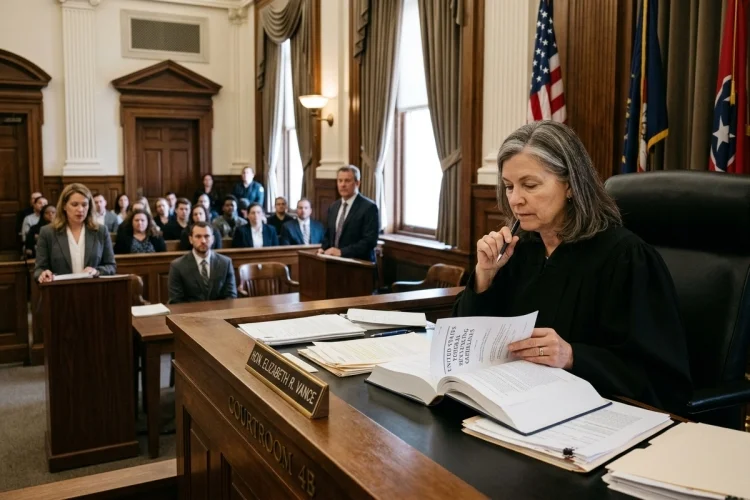
A guilty verdict does not automatically tell you what punishment someone will receive. Two people convicted of similar crimes can sometimes receive different sentences because sentencing depends on much more than the name of the offense.
So, how do judges determine criminal sentences?
In the U.S. federal system, judges start with the law passed by Congress, which may establish minimum and maximum penalties for an offense.
They also calculate and consider the advisory Federal Sentencing Guidelines, review the defendant’s criminal history and personal circumstances, examine the seriousness of the offense, and consider arguments from prosecutors and defense lawyers.
Victims and defendants may also speak before the final sentence is imposed. The goal is not simply to choose the harshest possible punishment.
Federal law directs courts to impose a sentence that is “sufficient, but not greater than necessary” to accomplish recognized sentencing purposes.
Here is how that process works.
Sentencing Happens After a Guilty Plea or Conviction
Before a judge determines a criminal sentence, the defendant must first be found guilty.
That can happen after a trial, where a judge or jury returns a guilty verdict, or when the defendant enters a guilty plea.
In many cases, a defendant who pleads guilty will return to court later for a separate sentencing hearing.
A plea agreement can contain recommendations or agreements involving sentencing, but depending on the type of agreement, the judge may still have significant authority over the final punishment.
This distinction is important.
The prosecutor may request a particular sentence. The defense may argue for something lighter. But in federal court, the judge is responsible for actually imposing the sentence.
Step 1: Judges Look at the Penalties Allowed by Law
The first major limitation on a judge is the criminal statute itself.
Congress determines the penalties available for federal crimes. Some statutes establish maximum sentences, minimum sentences, fines, or combinations of different penalties.
Imagine a federal statute says an offense carries a maximum prison sentence of 10 years.
A judge generally cannot simply decide to impose 20 years for that offense unless another applicable law authorizes additional punishment.
Some federal crimes also carry mandatory minimum sentences.
When a mandatory minimum applies, judicial discretion can become more limited unless a statutory exception permits a lower sentence.
So while people sometimes say judges can “choose any sentence they want,” that is inaccurate. Sentencing decisions operate inside legal boundaries created by Congress.
Step 2: A Presentence Investigation Is Conducted
Before sentencing in most federal felony cases, a probation officer prepares a Presentence Investigation Report, commonly called a PSR.
This report gives the judge a much broader picture than the conviction alone.
The probation officer may investigate the defendant’s family background, education, employment, finances, criminal history, physical and mental health, and substance-use history.
The investigation also examines the offense itself and may include information from law enforcement and victims.
The PSR then summarizes information relevant to sentencing, including the applicable advisory Sentencing Guidelines.
Defense lawyers and prosecutors can review the report and raise objections if they believe important facts or guideline calculations are incorrect.
This process matters because sentencing can depend heavily on details.
For example, two defendants may be convicted under the same statute, but one may have an extensive criminal history while the other has no prior convictions.
Those differences can influence the sentencing analysis.
Step 3: The Federal Sentencing Guidelines Are Calculated
One of the most important parts of federal sentencing is the U.S. Sentencing Guidelines.
The guidelines provide a structured system for calculating a recommended sentencing range.
The process generally starts with the seriousness of the offense. Specific characteristics of the crime can increase or decrease the guideline calculation, while the defendant’s prior criminal record helps determine a criminal history category.
These components eventually produce an advisory sentencing range.
For example, imagine two defendants are convicted of comparable financial crimes.
One played a minor role and has no criminal history. The other organized the scheme, caused greater losses, and has several prior convictions.
Even though the basic offense may look similar, their guideline calculations could be very different.
The Guidelines therefore try to make sentencing more consistent while still accounting for meaningful differences between cases.
Are the Sentencing Guidelines Mandatory?
No—not in the modern federal sentencing system.
The Federal Sentencing Guidelines were originally designed to operate much more rigidly. But after the Supreme Court’s 2005 decision in United States v. Booker, they became advisory rather than mandatory.
Federal judges must still correctly calculate and seriously consider the applicable guideline range, but they are not automatically required to impose a sentence inside that range.
That does not make the Guidelines irrelevant.
The U.S. Sentencing Commission describes the guideline calculation as a starting point in the sentencing process. Judges then consider the broader statutory sentencing factors established by Congress.
This creates a balance between nationwide consistency and individualized sentencing.
Step 4: Judges Consider the Section 3553(a) Factors
One of the most important federal sentencing laws is 18 U.S.C. § 3553(a).
It tells judges to consider several factors before selecting the final sentence.
These include the nature and circumstances of the offense, the defendant’s history and characteristics, the available types of punishment, the need to avoid unwarranted sentencing disparities, and the need to provide restitution to victims.
Judges must also consider what the sentence is supposed to accomplish.
1. Punishment
A sentence may reflect the seriousness of the crime and provide a level of punishment considered appropriate.
2. Deterrence
The court may consider whether the sentence could discourage the defendant or others from committing similar crimes.
3. Protecting the Public
In some cases, imprisonment or another restriction may be considered necessary to reduce the risk of further criminal conduct.
4. Rehabilitation
Courts may also consider needs involving education, vocational training, medical care, or other correctional treatment.
The important idea is that sentencing is not based on only one goal.
A judge may have to balance several objectives at the same time.
Step 5: Aggravating and Mitigating Factors Matter
Judges also hear arguments about circumstances that make the offense more or less serious.
Aggravating factors can support a harsher sentence.
For example, a crime involving significant harm, abuse of a position of trust, repeated criminal behavior, or particularly serious conduct may create arguments for greater punishment depending on the applicable law and Guidelines.
Mitigating factors can support leniency.
A defense lawyer might discuss the defendant’s personal circumstances, limited role in the offense, rehabilitation efforts, medical issues, lack of prior criminal history, or other relevant facts.
The judge does not automatically accept either side’s argument.
Instead, the court considers those circumstances alongside the statute, Guidelines, PSR, and other sentencing factors.
This is one reason two people convicted of similar offenses can receive different outcomes without the sentences necessarily being inconsistent.
Step 6: Criminal History Can Influence the Sentence
A defendant’s past record is often important.
The federal Guidelines specifically incorporate criminal history into the recommended sentencing range. A defendant with several qualifying previous convictions may fall into a higher criminal history category than someone with little or no prior record.
But criminal history is not simply a matter of counting every previous encounter with police.
The Guidelines contain detailed rules governing which prior sentences count and how they affect the calculation.
From a practical perspective, this explains why headlines saying two defendants committed “the same crime” may not tell the whole story.
Their legal histories can be very different.
Step 7: Victims and the Defendant Can Speak
Sentencing is not simply a conversation between lawyers and the judge.
Federal Rule of Criminal Procedure 32 gives the defendant an opportunity to personally address the court before sentencing. This is known as allocution.
The defendant may apologize, explain personal circumstances, describe rehabilitation efforts, or provide other information relevant to sentencing.
Victims who are present also have a right to be reasonably heard before the sentence is imposed.
Victim statements can explain financial, physical, psychological, or social harm caused by the offense.
These statements do not give either the defendant or victim the power to select the sentence.
The judge remains responsible for making the legal decision.
Step 8: The Judge Chooses the Final Sentence
After reviewing the statute, Guidelines, presentence report, objections, sentencing arguments, victim information, and the defendant’s statement, the judge imposes the sentence.
Federal punishment is not limited to prison.
Depending on the crime and applicable law, sentencing options may include imprisonment, probation, supervised release, fines, restitution, forfeiture, or combinations of these consequences.
The Guidelines contain provisions addressing imprisonment, probation, supervision, fines, and restitution.
The judge must also explain the reasoning behind the sentence.
Federal law requires courts to state reasons for imposing a particular sentence, including specific reasoning when sentencing outside the applicable guideline range.
This requirement supports transparency and makes later appellate review possible.
A Simple Sentencing Example
Imagine two people are convicted of participating in similar fraud schemes.
Defendant A has no prior criminal convictions, played a relatively limited role, accepted responsibility, and has begun repaying victims.
Defendant B organized the scheme, has a substantial criminal record, and caused significantly greater harm.
The crime’s statutory penalties provide the outer legal boundaries.
The Sentencing Guidelines then help calculate recommended ranges based on relevant offense and offender characteristics. The judge considers the PSR, arguments from both sides, victim statements, and the broader § 3553(a) factors.
The judge may ultimately conclude that different sentences are appropriate.
That does not necessarily mean the system treated identical defendants differently. It may mean the law recognized important differences between their conduct and backgrounds.
Can a Criminal Sentence Be Appealed?
In some circumstances, yes.
Federal Rule of Criminal Procedure 32 requires the court to advise defendants about any applicable right to appeal the sentence.
An appellate court can review sentencing issues, including certain claims involving incorrect guideline calculations, legal errors, or unreasonable sentences.
However, an appeal is not simply another opportunity to ask a different judge for a lighter punishment.
Appellate review follows specific legal standards, and plea agreements can sometimes affect the scope of available appellate rights.
So, how do judges determine criminal sentences? In the U.S. federal system, sentencing begins with the penalties authorized by Congress.
Judges then calculate the advisory Sentencing Guidelines, review the presentence report, consider criminal history, hear arguments from prosecutors and defense lawyers, and evaluate the factors required by federal law.
Victim impact, mitigating circumstances, aggravating conduct, restitution, deterrence, public safety, and rehabilitation can all influence the final decision.
The result is a process designed to combine consistency with individualized judgment.
When reading about a criminal sentence, do not look only at the number of years imposed. Ask about the statutory range, guideline calculation, criminal history, offense circumstances, and judge’s stated reasons. Those details usually explain much more.