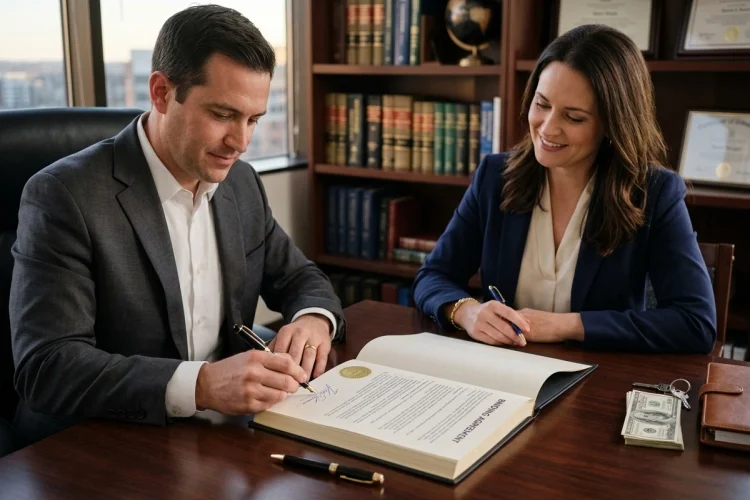
People make agreements every day. You might hire someone to repair your home, subscribe to an online service, buy a used car, or agree to do freelance work for a client.
But not every promise automatically becomes a legally enforceable contract.
So, what makes a contract legally binding?
Under U.S. contract law, an enforceable contract generally requires several basic elements, including mutual assent, consideration, legal capacity, and a lawful purpose. Mutual assent is normally shown through a valid offer and acceptance.
Some agreements must also satisfy special requirements, such as being in writing. Others can be enforceable even when they were made verbally.
Contract law is primarily governed by state law, so the exact rules can vary from one jurisdiction to another. Different rules may also apply depending on whether the agreement involves services, real estate, employment, or the sale of goods.
Understanding the basic elements makes it much easier to recognize when an everyday agreement may create real legal obligations.
What Is a Legally Binding Contract?
A legally binding contract is an agreement that creates obligations the law can enforce.
Imagine you agree to pay a photographer $1,000 to photograph your wedding, and the photographer agrees to provide eight hours of coverage on a specific date.
Both sides have made promises.
If the agreement satisfies the legal requirements for a valid contract, one party may have legal remedies if the other fails to perform.
Cornell’s Legal Information Institute describes a contract as an agreement between parties that creates mutual obligations enforceable by law. The basic elements commonly include mutual assent, consideration, capacity, and legality.
This is what separates an enforceable agreement from a casual promise.
Telling a friend, “I’ll buy you lunch someday,” for example, would normally not create the same legal obligations as signing an agreement to purchase a vehicle for a specified price.
1. There Must Be a Valid Offer
Most contracts begin with an offer.
An offer is a sufficiently definite proposal showing that one party is willing to enter into a contract if the other party accepts.
Suppose a painter tells a homeowner:
“I will paint your living room for $800, including materials, if you agree by Friday.”
That statement identifies the service, price, and deadline for acceptance. Depending on the surrounding circumstances, it could constitute an offer.
An offer must generally communicate an intention that acceptance will create a binding agreement. Cornell explains that an offer should be expressed in a way that would lead a reasonable person to understand that accepting it can create a contract.
Not every advertisement or negotiation is automatically an offer.
A business advertisement saying “laptops starting at $500,” for example, may simply invite customers to make purchases rather than promise to sell a particular laptop to every person who responds.
Context matters.
2. The Other Party Must Accept the Offer
An offer alone does not create a contract.
The other party generally needs to accept it.
Acceptance means agreeing to the terms of the offer in a legally recognized manner. It can sometimes be communicated through words and sometimes through conduct.
Return to the painting example.
If the homeowner replies, “I accept your offer to paint the living room for $800,” the acceptance is straightforward.
But suppose the homeowner says:
“I’ll pay $650 instead.”
That response is usually not an acceptance of the original offer. It may function as a counteroffer instead.
The details become especially important in commercial transactions.
For sales of goods, Uniform Commercial Code rules can allow acceptance through reasonable methods, including certain forms of performance such as shipping goods in response to an order.
The basic idea remains the same: both sides must objectively communicate agreement.
3. There Must Usually Be Consideration
One of the most important concepts in U.S. contract law is consideration.
Consideration means that the parties exchange something of legal value.
It does not necessarily have to be money.
A person might promise to provide services, deliver property, perform an action, or refrain from doing something they otherwise have a legal right to do.
Suppose a homeowner agrees to pay a contractor $5,000 in exchange for installing new flooring.
The contractor’s promise to perform the work is consideration for the homeowner’s promise to pay, while the homeowner’s promise to pay is consideration for the contractor’s work.
Cornell describes consideration as the reciprocal exchange of promises or obligations needed for most enforceable contracts.
Why Gifts Are Different
Consideration helps distinguish contracts from gifts.
Imagine an uncle tells his nephew:
“I’ll give you $500 next month as a birthday present.”
If the nephew gives nothing in exchange, that may simply be a gratuitous promise rather than a contract.
By contrast, if the uncle says, “I’ll pay you $500 if you paint my garage,” the exchange looks much more like contractual consideration.
There are exceptions and alternative doctrines in some circumstances, but consideration remains one of the central concepts in traditional U.S. contract law.
4. The Parties Need Legal Capacity
A person must generally have sufficient legal capacity to enter into a binding agreement.
Capacity relates to whether someone is legally capable of understanding and participating in the transaction.
Age is one common example.
Contracts involving minors may be voidable or subject to special rules, although exceptions can apply depending on state law and the type of transaction.
Mental capacity can also become relevant.
Cornell explains that contract capacity commonly requires a person to meet legal requirements such as minimum age and sufficient mental ability. Agreements involving someone who lacks capacity may be void or voidable depending on the circumstances.
This does not mean every bad deal can be canceled because someone later regrets signing it.
Capacity is a specific legal issue, not simply a claim that a person failed to read the agreement carefully.
5. The Contract Must Have a Lawful Purpose
Courts generally will not enforce agreements requiring illegal conduct.
Imagine two people agree that one will pay the other $10,000 to illegally hack a competitor’s computer system.
Even if there is an offer, acceptance, and payment, the agreement involves unlawful activity.
That creates a fundamental enforceability problem.
Legality is therefore one of the basic elements identified in traditional contract law.
Public policy can also matter.
Some contractual provisions may be unenforceable even when the entire agreement is not obviously criminal. Courts may refuse to enforce terms that violate statutes or established public policy.
The precise analysis depends heavily on state law and the subject of the contract.
6. The Parties Must Actually Agree on the Deal
Contract law often uses the term mutual assent.
In everyday language, this means that the parties objectively agreed to the transaction.
The traditional idea is sometimes described as a “meeting of the minds,” although courts usually focus on outward words and conduct rather than trying to read someone’s private thoughts.
Suppose a customer thinks they are buying a car for $15,000 while the seller’s written offer clearly states $25,000.
If there was genuine confusion about a fundamental term, the court may need to determine whether a real agreement was formed.
Contract terms also generally need to be sufficiently definite for a court to understand what the parties promised.
Important terms may include price, subject matter, quantity, timing, or the work to be performed.
A vague statement such as “I’ll probably pay you something reasonable someday” creates far more uncertainty than “I’ll pay you $2,000 on September 1 for designing my website.”
7. Does a Contract Have to Be in Writing?
No.
This is one of the most common contract-law misconceptions.
Many oral agreements can be legally binding if the necessary contractual elements exist.
However, certain agreements must generally be evidenced by a writing because of rules commonly known as the Statute of Frauds.
Cornell explains that common categories include contracts involving transfers of land and agreements that cannot be performed within one year.
The Uniform Commercial Code also contains a writing requirement for many contracts involving sales of goods priced at $500 or more, subject to several exceptions.
Because states adopt and sometimes modify their own versions of these rules, the precise requirements can differ.
Even when a written contract is not legally required, putting an important agreement in writing is usually practical.
Written terms can make it easier to prove what the parties actually agreed to if a dispute develops later.
Do Contracts Need a Signature?
Not always.
A handwritten signature is strong evidence that someone agreed to written terms, but contract formation does not universally depend on putting ink on paper.
Some agreements can arise orally or through conduct.
Electronic contracts are also common.
Under the federal E-SIGN Act, a contract or signature involving interstate or foreign commerce generally cannot be denied legal effect solely because it is electronic.
That is why clicking an acceptance button, signing electronically, or completing certain online transactions can potentially create enforceable agreements.
However, electronic form does not magically fix an invalid contract.
The ordinary requirements involving assent, capacity, legality, and other applicable rules still matter.
What About Contracts for the Sale of Goods?
Contract law in the United States is not governed entirely by one rulebook.
Traditional state common law generally governs many contracts involving services, employment, real estate, and other arrangements.
Sales of goods are commonly governed by state versions of Article 2 of the Uniform Commercial Code, or UCC.
The UCC defines goods broadly as movable things identified to a contract and provides specialized rules for commercial sales.
Suppose a company orders 500 office chairs from a manufacturer.
That transaction may involve UCC rules about contract formation, shipment, warranties, rejection of nonconforming goods, and remedies.
A contract to hire an architect to design an office building, however, is mainly a services agreement and generally follows different contract-law principles.
Knowing what kind of transaction you are dealing with is therefore an important first step.
What Happens If Someone Breaks a Binding Contract?
Failure to perform a contractual obligation can result in a breach of contract.
Suppose a photographer accepts payment and agrees to attend a wedding but fails to appear without a legally valid excuse.
The client may be entitled to pursue a remedy.
Contract remedies can include monetary damages intended to compensate for losses caused by the breach.
In some situations, courts may also award reliance-based remedies or order specific performance, requiring a party to perform a contractual obligation when monetary damages are inadequate.
Not every breach automatically produces a large financial award.
The available remedy depends on the contract, the type of breach, the losses that can legally be proven, applicable limitations, and state law.
A Simple Contract Example
Imagine Emma offers to sell Noah her used laptop for $700.
Noah accepts.
Emma agrees to deliver the laptop on Saturday, and Noah agrees to pay the $700 when it arrives.
There is a clear offer and acceptance. Each side provides consideration: the laptop on one side and $700 on the other.
Assuming both parties have legal capacity and the transaction is lawful, the agreement has several core characteristics of an enforceable contract.
Now change the facts.
If Emma simply says, “Maybe I’ll give you my laptop someday,” there may be no definite offer.
If Noah responds, “I’ll pay $400,” he may have made a counteroffer instead of accepting.
Small factual changes can completely alter whether a contract exists.
So, what makes a contract legally binding? In U.S. contract law, the foundation usually includes a valid offer, acceptance, consideration, legal capacity, and a lawful purpose. The parties must also objectively demonstrate agreement to sufficiently definite terms.
A contract does not always need to be written or signed on paper. Oral agreements and electronic contracts can sometimes be enforceable, although special rules require writings for certain transactions.
Because contract law is primarily governed by state law, specific requirements can vary.
Before entering an important agreement, read the terms carefully, put significant promises in writing, and understand exactly what each party is expected to do.
For high-value or complicated transactions, getting jurisdiction-specific legal advice can prevent much bigger problems later.