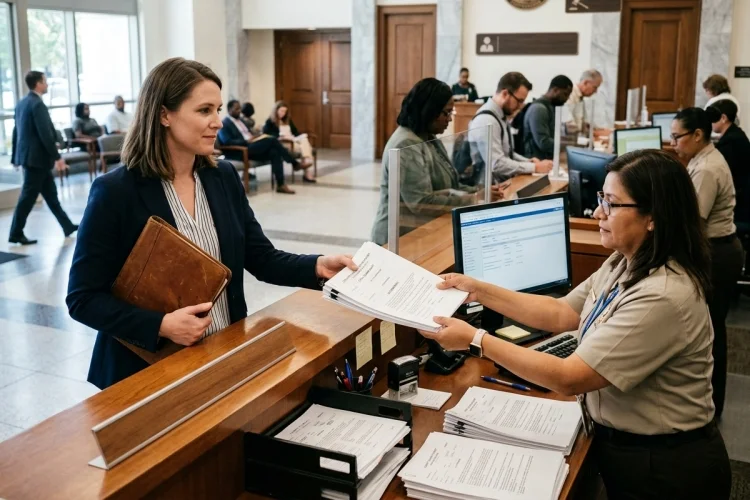
A civil lawsuit rarely begins with dramatic courtroom arguments. Long before witnesses testify or a jury hears evidence, someone has to identify a legal claim, choose the right court, prepare a complaint, file it, and formally notify the other side.
So, how does a civil lawsuit begin?
In the United States, a civil case usually involves a dispute between individuals, businesses, organizations, or sometimes government entities.
Unlike a criminal prosecution, where the government accuses someone of committing a crime, a civil lawsuit generally involves one party seeking compensation, an injunction, or another legal remedy from another party.
In federal court, a civil action officially begins when the plaintiff files a complaint with the court. The plaintiff must then arrange for the defendant to receive proper legal notice through a process known as service of process.
The details can become complicated, but the opening stages follow a fairly logical sequence. Here is how the process works.
What Is a Civil Lawsuit?
A civil lawsuit is a legal dispute in which one party asks a court to provide a remedy against another party.
The person or organization starting the case is generally called the plaintiff. The party being sued is called the defendant.
Imagine a contractor agrees to renovate a kitchen for $30,000 but abandons the project after receiving most of the payment.
The homeowner might sue for breach of contract and seek money damages.
Another lawsuit might involve a driver injured in a car accident, an employee alleging unlawful workplace conduct, a company fighting over intellectual property, or a property owner asking a court to stop someone from interfering with land rights.
Federal courts hear certain civil cases, but they have limited jurisdiction. Most civil cases in the United States are actually filed in state courts.
Step 1: Identify the Legal Claim and Desired Remedy
Before filing anything, the potential plaintiff needs to identify the legal basis for the lawsuit.
Being angry, disappointed, or financially harmed does not automatically create a valid legal claim.
The plaintiff must generally connect the facts to a recognized legal cause of action.
For example, if a business fails to deliver products after accepting payment, the dispute might involve breach of contract. If a careless driver causes an accident, the injured person may consider a negligence claim.
The plaintiff should also decide what they want the court to do.
The requested remedy might include money damages, an injunction ordering someone to stop certain conduct, or a declaration explaining the parties’ legal rights. U.S. Courts notes that civil plaintiffs may seek compensation, an order stopping harmful conduct, or other forms of judicial relief.
This early analysis matters because the legal claim and requested remedy shape almost everything that follows.
Step 2: Choose a Court With Jurisdiction
One of the biggest mistakes a beginner can make is assuming any courthouse can hear any lawsuit.
Courts need jurisdiction, meaning legal authority to hear the dispute.
Federal courts are courts of limited jurisdiction. Two major categories of federal civil jurisdiction are federal-question jurisdiction and diversity jurisdiction.
1. Federal-Question Jurisdiction
Federal-question cases involve issues arising under the U.S. Constitution, federal statutes, or other federal law.
For example, a lawsuit alleging violation of a federal civil-rights statute might qualify for federal jurisdiction.
2. Diversity Jurisdiction
Certain disputes between parties from different states or countries may also qualify for federal court if statutory requirements-including the required amount in controversy-are satisfied.
Jurisdiction can become highly technical.
A plaintiff must also consider venue, which deals with the appropriate geographic location for the lawsuit.
Simply choosing the most convenient courthouse does not necessarily make it legally proper.
Step 3: Prepare the Complaint
The complaint is the document that formally sets out the plaintiff’s case.
Federal Rule of Civil Procedure 8 generally requires a pleading seeking relief to include a short and plain statement explaining the court’s jurisdiction, a statement showing why the plaintiff is entitled to relief, and a demand describing the remedy requested.
Suppose Sarah sues a delivery company after one of its drivers allegedly causes an accident.
Her complaint might identify the parties, explain where the accident happened, describe the driver’s alleged negligence, outline her injuries, establish why the federal court has jurisdiction, and request damages.
A complaint does not need to contain every piece of evidence the plaintiff plans to use later.
It establishes the basic allegations and legal claims.
Facts Still Matter
Although federal pleading rules emphasize relatively concise statements, a complaint cannot simply say:
“The defendant harmed me, so I deserve money.”
The plaintiff needs enough factual and legal substance to state a valid claim.
Certain claims also have special pleading requirements beyond the basic Rule 8 standard.
Preparing the complaint carefully matters because defects can lead to motions asking the court to dismiss some or all of the case.
Step 4: File the Complaint With the Court
Once the complaint is prepared, it must be filed.
Federal Rule of Civil Procedure 3 is remarkably short: a civil action begins by filing a complaint with the court.
The plaintiff generally pays a filing fee.
Someone who cannot afford that fee may ask the federal court for permission to proceed in forma pauperis. If the request is granted, the person may proceed without paying the normal filing fee upfront.
Filing is more important than simply submitting paperwork.
It officially places the dispute into the court system and creates the federal civil case.
Deadlines matter as well.
Civil claims are generally subject to statutes of limitation, which can prevent lawsuits from being brought after too much time has passed. Which deadline applies depends on the claim and governing law.
Step 5: The Defendant Must Receive Legal Notice
Filing the lawsuit does not usually complete the opening process.
The defendant must be properly notified.
This is known as service of process.
Under Federal Rule of Civil Procedure 4, a summons must generally be served together with a copy of the complaint. The summons tells the defendant that a lawsuit has been filed and explains the deadline for responding.
Service rules are detailed because due process requires defendants to receive proper notice and an opportunity to respond.
A plaintiff usually cannot simply send a casual text saying:
“By the way, I’m suing you.”
Federal law establishes recognized methods for serving individuals, businesses, government entities, and parties located outside the United States.
Waiving Formal Service
In some federal cases, a plaintiff can ask a defendant to waive formal service.
Waiving service does not mean the defendant admits liability.
It simply avoids the expense and formality of having the summons formally served. A defendant who timely waives service generally receives additional time to respond.
Step 6: The Defendant Responds
Once properly served, the defendant cannot simply ignore the lawsuit without risking consequences.
A common response is an answer.
In an answer, the defendant generally admits or denies the allegations and states applicable defenses. Federal Rule 8 requires defendants to respond to the substance of allegations and identify affirmative defenses when required.
Imagine the complaint says:
“Defendant failed to deliver the goods by June 1.”
The defendant might admit the contract existed but deny breaching it, perhaps arguing that the plaintiff had already canceled the order.
A Defendant May File a Motion Instead
The defendant may sometimes respond with a motion under Federal Rule of Civil Procedure 12.
A Rule 12 motion can raise issues such as lack of jurisdiction, improper venue, insufficient service, or failure to state a claim upon which relief can be granted.
For many defendants, the normal federal deadline to answer is 21 days after service of the summons and complaint, although different deadlines can apply depending on circumstances such as waiver of service.
Ignoring the case can create a risk of default judgment, meaning the plaintiff may potentially obtain relief because the defendant failed to defend the lawsuit.
Step 7: The Parties Move Toward Discovery
Once the initial pleadings are underway, the case begins moving from allegations toward evidence.
This stage is called discovery.
Discovery allows parties to obtain information relevant to claims and defenses. That can include documents, electronically stored information, witness information, written questions, requests for admissions, and depositions.
Federal Rule of Civil Procedure 26 generally requires parties to confer about the case and create a discovery plan. In many federal cases, parties must also provide initial disclosures containing specified information they may use to support their claims or defenses.
Suppose a lawsuit involves a workplace accident.
The plaintiff might seek safety records, emails, training documents, photographs, and witness testimony.
The defendant might request medical records or information about the plaintiff’s claimed damages.
Discovery can become one of the longest and most expensive parts of civil litigation.
Does Filing a Lawsuit Mean There Will Be a Trial?
No.
This is another common misconception.
A lawsuit may begin with a complaint, but that does not mean the parties will eventually argue before a jury.
Some cases are dismissed early because of legal problems.
Others settle after the parties exchange information and better understand the strengths and weaknesses of their positions. Courts may also resolve certain issues through pretrial motions.
U.S. Courts explains that civil cases can proceed through discovery and other preparation before trial, but parties may also settle the dispute instead of completing the entire trial process.
A settlement can happen almost anytime.
For example, two businesses fighting over a $200,000 contract might decide that spending another year on litigation makes less sense than negotiating a compromise.
Starting a civil lawsuit therefore begins a process-it does not guarantee how that process will end.
A Simple Civil Lawsuit Example
Imagine Daniel pays a construction company $50,000 to renovate his home.
The company allegedly completes only half the work and refuses to return the unused money.
Daniel believes he has a breach-of-contract claim.
First, he identifies the legal basis of the dispute and checks the applicable filing deadline.
Next, he determines which court has jurisdiction and whether the case belongs in state or federal court.
If federal jurisdiction exists, he prepares a complaint explaining the dispute, the basis for jurisdiction, and the relief he wants.
He files the complaint and obtains a summons.
The construction company is then properly served.
The company files an answer denying some allegations and raising defenses.
After that, the parties begin exchanging information through discovery.
Only then does the dispute start moving toward potential settlement, pretrial motions, or a trial.
That is a much more realistic picture of how civil litigation begins than the instant courtroom battles shown on television.
So, how does a civil lawsuit begin? In U.S. federal court, the formal starting point is the filing of a complaint. But successful litigation requires important steps both before and immediately after filing.
The plaintiff must identify a valid legal claim, choose a court with jurisdiction, prepare the complaint, file it, and properly serve the defendant. The defendant then has an opportunity to answer or raise legal objections before the case moves toward discovery and other pretrial proceedings.
Most importantly, filing a complaint is only the beginning-not a victory.
When following a civil case, pay attention to jurisdiction, the claims in the complaint, service of process, the defendant’s response, and early motions. Those details often determine whether a lawsuit moves forward at all.